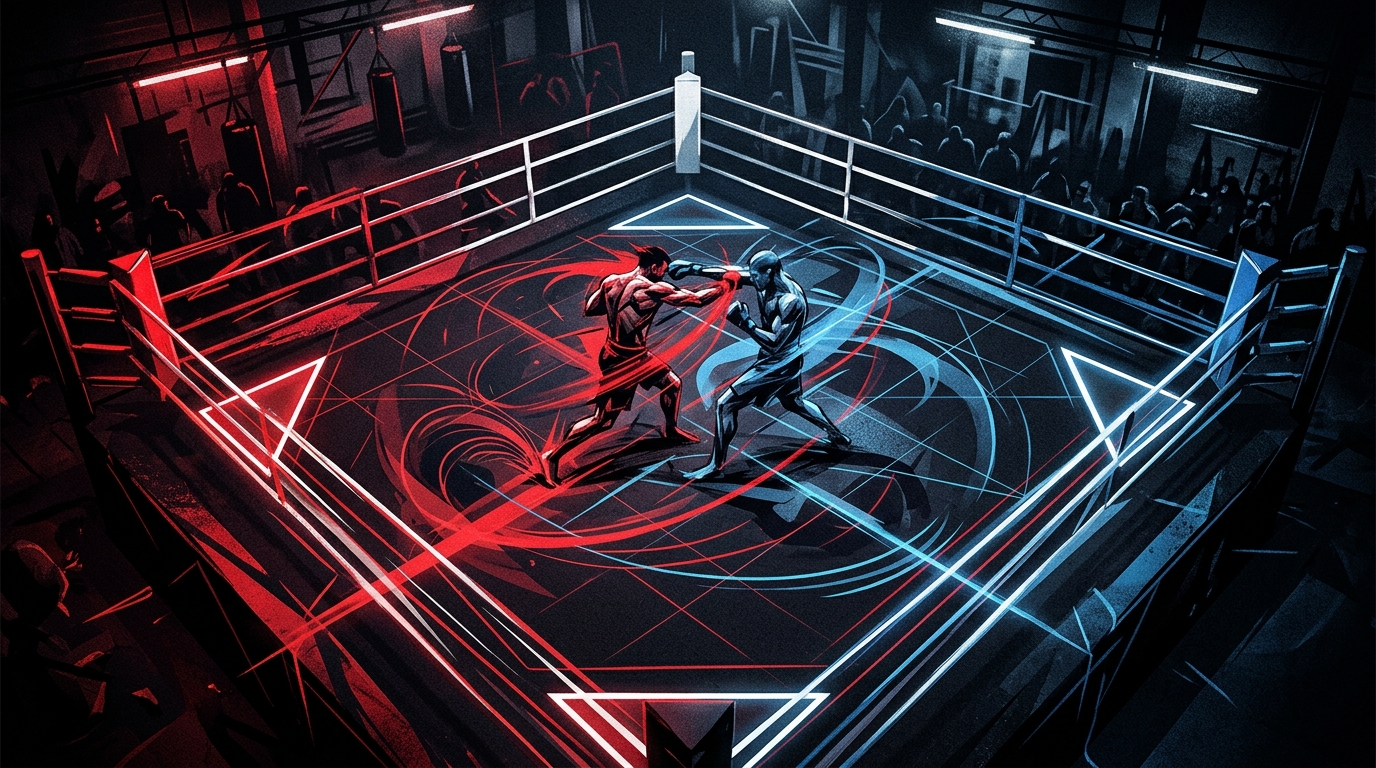
In the world of combat sports, there's a concept that separates good fighters from true champions: the ability to create and exploit angles. We're not just talking about hitting hard or being fast, but positioning yourself in space so that every shot you throw has maximum impact while your opponent's punches slip into empty air. It's geometry applied to controlled violence, and it's the element that makes certain athletes practically untouchable.
When we watch a high-level fight, we often comment on speed or power, but rarely notice the real tactical genius: the angular movement that creates opportunities where none apparently exist. The champions who dominated their eras weren't necessarily the strongest or fastest, but they were masters at turning the ring into a geometric maze where only they knew the exits.
Ring Geometry: Why Angles Matter
The ring or cage are defined spaces, creating precise geometry that experienced fighters know how to exploit. When you move in a straight line toward your opponent or directly away from them, you're predictable. You're on what coaches call "the firing line," where both of you can hit each other with maximum effectiveness.
Angles change everything. By moving laterally while advancing or retreating, you create an asymmetrical situation: you can hit your opponent, but they must first realign to respond effectively. Champions live in that split-second advantage.
Vasyl Lomachenko built his legend precisely on this principle. His style, forged through years of traditional Ukrainian dance that his father imposed on him as a child, is based on never being where the opponent expects. Lomachenko doesn't just dodge—he constantly repositions himself at angles that render his opponents helpless. Against Guillermo Rigondeaux in 2017, one of the most technically refined boxers of his generation, Lomachenko literally created angles so extreme that Rigondeaux retired after six rounds with an alleged hand injury, likely frustrated by the impossibility of hitting a target that seemed to exist in multiple positions simultaneously.
The Pivot: The Movement That Changes Everything
The pivot is the fundamental movement for creating angles. It involves rotating on a pivot foot while the other describes an arc, allowing you to move laterally relative to your opponent while maintaining optimal striking distance.
In boxing, the pivot is often executed on the lead foot when you want to exit to the outside after an offensive action. Floyd Mayweather Jr. perfected this technique until it became instinctive. Watching his fights against orthodox fighters like Canelo Álvarez (September 2013), we notice how Floyd used the pivot on his left foot after throwing his jab or right hand, moving to his left (the outside relative to his orthodox opponent's guard). This positioned him out of the counterattack line while keeping his right hand in perfect position to strike.
In kickboxing and Muay Thai, the pivot takes on additional dimensions because you must also consider kicks. Giorgio Petrosyan, arguably the most technically refined kickboxer of the modern era, uses the pivot not only to create angles but to nullify opponents' low kicks. When an opponent throws a low kick at his lead leg, Petrosyan often pivots in that direction, drastically reducing the impact and immediately positioning himself for a counterattack.
The Blind Spot: Where Punches Become Invisible
Every fighter has angles where their perception is reduced and defensive capability is compromised. Identifying and exploiting these "blind spots" is what distinguishes an excellent tactician from a simple brawler.
For an orthodox boxer, the most dangerous angle is typically to their rear right, where peripheral vision is limited and the left arm (the jab) can't reach you effectively. Experienced southpaws live in this space. Marvin Hagler, the legendary middleweight southpaw, built entire strategies around the concept of "living in the blind spot" of his orthodox opponent.
Israel Adesanya, the former UFC middleweight champion, brought this concept to MMA with almost scientific awareness. Standing 6'4" with an 80-inch reach, "The Last Stylebender" uses his length not just to maintain distance, but to constantly position himself at angles where his opponents must make significant adjustments before attacking. In his first fight against Robert Whittaker (October 2019), Adesanya showed extraordinary ability circling to Whittaker's right (southpaw), repeatedly positioning himself where Whittaker's powerful left hand needed a complex setup to reach him, while his right jab could peck freely.
The Difference Between Boxing and Kickboxing Angles
Angles work differently when you add kicks to the equation. In boxing, you can afford to lean laterally and lower your torso to create more extreme angles. In kickboxing and Muay Thai, this strategy exposes you to knees and head kicks.
Samart Payakaroon, considered by many the greatest nak muay of all time before transitioning to boxing where he also won a WBC title, perfectly demonstrated this difference. In Muay Thai, Samart created angles primarily with footwork and the teep (push kick), keeping his torso relatively upright. When he switched to boxing in the '80s, suddenly his ability to bend and create angles with torso movement exploded, because he no longer had to worry about knees and roundhouse kicks.
This fundamental difference explains why we see more "squared-up" movement and higher guards in kickboxing versus boxing. Rico Verhoeven, the Dutch heavyweight kickboxing dominator, creates angles primarily through lateral footwork and minimal level changes, always maintaining structure that allows him to check incoming kicks.
Cutting the Angle: When Pursuit Becomes Science
Creating angles is important, but so is "cutting" angles when your opponent tries to move laterally. This means not simply chasing your opponent, but anticipating their direction and intercepting them, reducing their available space.
Gennady Golovkin is a master at this. "GGG" doesn't chase his opponents by running after them; instead, he uses small lateral steps that cut off the ring, gradually forcing opponents toward the ropes. Against Daniel Jacobs (March 2017), one of the best movers at middleweight, Golovkin showed extraordinary patience in methodically reducing space, forcing Jacobs to fight more than planned and preventing him from using his superior footwork.
Cutting the angle requires understanding the geometry of movement: if your opponent moves in a circle to their right, you don't follow the same circle, but move in a smaller circle, essentially cutting the chord instead of following the entire arc. It's like cutting across a field instead of following the road around it.
In MMA, Kamaru Usman demonstrated this ability at an elevated level, because in the octagonal cage the angles are literally different. Usman pushes opponents toward the fence, cutting off their attempts to circle out, using both physical pressure and intelligent foot positioning.
Escaping the Corner: When You're the One Against the Ropes
Obviously, if angles can be used offensively, you must also know how to defend when you're the one trapped. The ropes or cage represent unfavorable geometry where your movement options are drastically reduced.
Experienced fighters have several strategies for escaping this trap. Juan Manuel Márquez, in his legendary battles against Manny Pacquiao, showed an interesting technique: instead of desperately trying to move laterally along the ropes (where Pacquiao would pursue him), he often stepped forward TOWARD Pacquiao while throwing a counter-punch, essentially reversing the dynamic and forcing Pacquiao to be the one retreating.
Another technique is the "roll and escape" where the fighter rolls under an incoming shot while simultaneously pivoting out of the corner. Muhammad Ali did this beautifully, though his preferred method was simply being too fast to get trapped in the first place.
In kickboxing, escaping the corner often involves a teep or clinch. Buakaw Banchamek, the Thai legend, used powerful teeps when pressured toward the ropes, creating space and often following with a quick lateral movement while the opponent recovered from the push.
What You Can Take to the Gym
Understanding theory is important, but practical application is what counts. Here are concrete drills to develop your understanding of angles:
- Single pivot drill: After every combination on the bag, execute a 90-degree pivot left or right. Focus on maintaining balance and keeping your guard high during the movement. Repeat until the pivot becomes as automatic as the punch itself.
- Circle drill with partner: One of you moves laterally in a circle, the other must "cut" the circle by moving in tighter arcs. No striking, just footwork. After two minutes, switch roles. This develops spatial awareness.
- Positional corner sparring: During light sparring, create specific scenarios: one starts with their back near the corner and must escape, the other must maintain angular pressure. Limit to 30 seconds per scenario, then switch.
- Bag visualization: Before starting the round, visualize an orthodox opponent in front of you. As you strike, imagine constantly moving toward "their" right (your left), creating favorable angles. Alternate rounds visualizing orthodox and southpaw opponents.
- Blind spot drill with coach: Your coach or partner holds pads in fixed positions while you move around creating angles. When you reach a point where the pads are difficult to see in your peripheral vision, strike immediately. This develops sensitivity to blind spots.
- Mirror work with angles: Practice combinations in front of the mirror, but after each sequence, move at 45 degrees. Observe how your reflection changes and how you must adapt your guard and posture.
Spatial Intelligence: The Hidden Gift of Champions
What all these examples reveal is that truly dominant champions possess what we might call "superior spatial intelligence." They don't consciously think about every angle during combat; they've internalized ring geometry until it becomes instinctive.
Lomachenko has stated in various interviews that he doesn't count punches or consciously think about his movements during a fight. His brain processes space and opponent movement at an almost subconscious level, the result of thousands of hours of specific training and that Ukrainian dance his father made him practice for years.
This ability can be developed, but it requires conscious and patient practice. Every time you enter the gym, instead of just thinking about "hitting harder" or "being faster," ask yourself: "Am I creating favorable angles? Am I making it difficult for my imaginary opponent to hit me while I can hit them?"
The difference between an amateur boxer and a high-level professional often doesn't lie in punching power or physical conditioning, but in this three-dimensional understanding of combat space. It's the ability to see the ring not as a flat surface but as a field of geometric possibilities, where every movement creates or closes opportunities.
When you study great champions, don't just watch what they hit and how hard. Observe WHERE they are when they strike, and especially where they AREN'T when the opponent tries to respond. You'll see that the best always seem to be in the right place at the right time, and that's not luck—it's geometry mastered through years of dedicated practice.
The art of angles is the art of transforming a two-dimensional space into a three-dimensional advantage, where time and space bend in your favor. That's where good fighters become great champions.