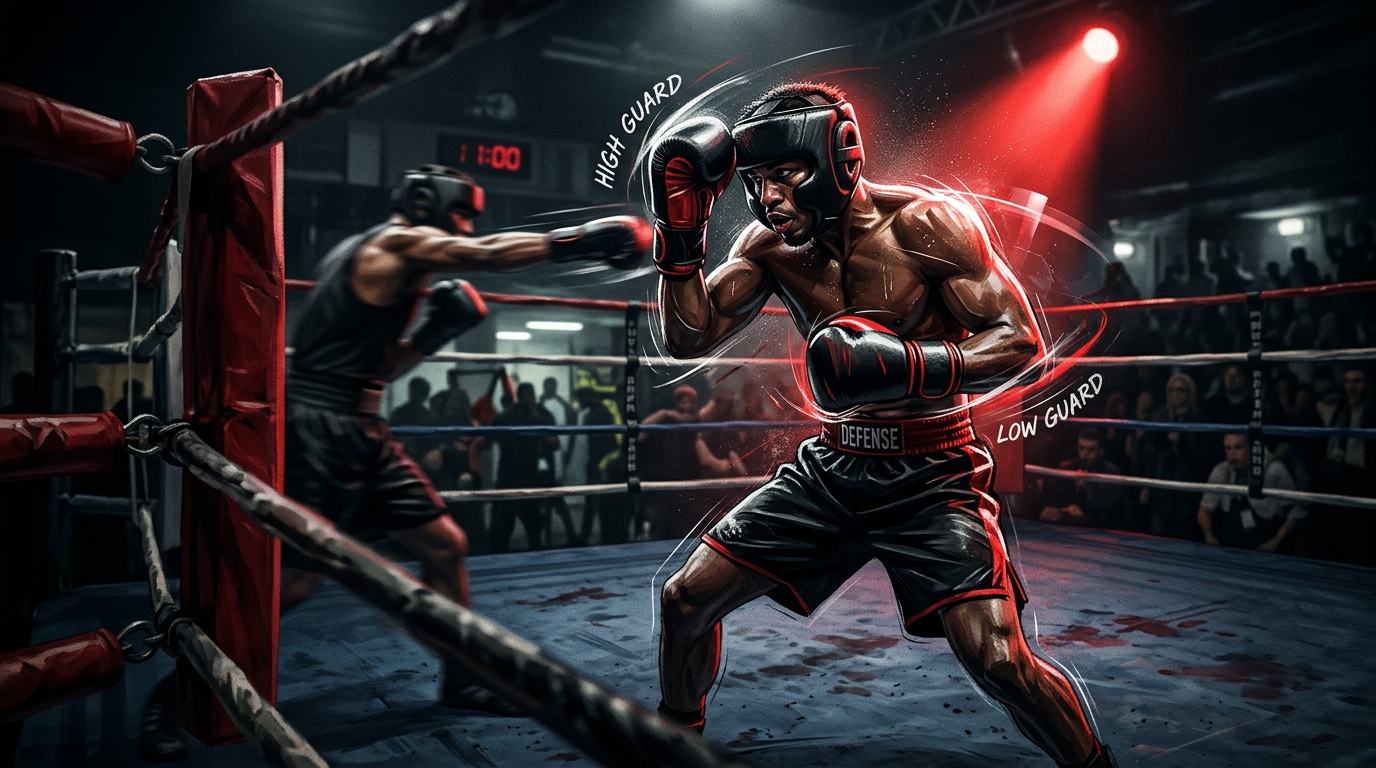
The Heresy That Works: When Rules Are Made to Be Broken
Every combat sports coach repeats the same mantra to beginners: "Keep your hands up!" Yet, watching any footage of Muhammad Ali, Anderson Silva, or Israel Adesanya, you'd think these champions never set foot in a gym. Hands dancing at chest level, chin jutting invitingly forward, posture defying every traditional defensive principle.
But this isn't arrogance for its own sake. Behind that seemingly careless guard lies a complex strategy built on lightning reflexes, millimeter-perfect distance control, and a deep understanding of opponent psychology. Deliberately dropping your guard is like walking a tightrope: it requires talent, preparation, and courage that borders on calculated madness.
In this article, we'll explore the technical, tactical, and psychological reasons why some elite fighters violate the most basic rule in combat sports, analyzing how this choice can transform from deadly risk to devastating strategic advantage.
The Science Behind the Paradox: Why It Works
Dropping your guard isn't simply a matter of style—it has precise biomechanical foundations. When hands drop to a lower position, the body gains greater lateral mobility. Shoulders relax, allowing more fluid and rapid torso movements. This principle is particularly evident in boxing and kickboxing, where the ability to "slip" laterally past punches becomes fundamental.
From a movement physics standpoint, a high, rigid guard creates muscular tension that slows reaction times. Constant tension in the deltoids and trapezius limits the speed at which the body can shift. Conversely, a relaxed posture allows faster neuromuscular responses to visual stimuli.
Take Vasyl Lomachenko: the Ukrainian champion often uses a variable guard, dropping his hands to invite opponents to attack certain lines. His training background in dance and artistic gymnastics provided superior proprioceptive awareness. When he drops his left hand, he's not making a mistake—he's creating a controlled opening, ready to explode with a counterpunch or evade with lateral movement.
In kickboxing and Muay Thai, the dynamics shift slightly. The presence of kicks requires different reads: dropping hands can prepare a check against a low kick or load up a powerful kick. Fighters like Nieky Holzken alternate between high and low guards fluidly, using lowered hands as bait to trigger devastating combinations.
Muhammad Ali: The Pioneer of the Low Guard
You can't discuss the open guard without citing "The Greatest." Muhammad Ali didn't invent the technique, but he transformed it into art. His approach was multidimensional: psychological first and foremost, but also tactical and athletic.
Ali possessed extraordinary foot speed for a heavyweight. His footwork allowed him to stay at mid-range with hands down, knowing he could exit punch trajectories in a split second. The famous "Rope-a-Dope" against George Foreman in 1974 perfectly exemplifies this: Ali switched from an extremely high guard on the ropes to a totally open posture when moving, drawing Foreman into unsustainable energy expenditure.
But Ali's low guard primarily served to provoke. Dropping your hands in front of an opponent essentially tells them "you're not fast enough to hit me." This psychological tactic frustrated opponents, pushing them to make mistakes, to overcommit seeking the decisive blow. And when they opened up, Ali's jab was waiting like a door slamming in their face.
Technically, Ali compensated for the low guard with constant head movement. His head movement wasn't random: continuous small oscillations that made it difficult for opponents to calculate exact distance. When hands are down, the head becomes both primary target and primary defensive tool.
Anderson Silva and Israel Adesanya: Evolution in MMA
MMA took the open guard to a higher complexity level. With kicks, knees, elbows, and the takedown threat, dropping your hands becomes even more dangerous. Yet Anderson Silva dominated the UFC middleweight division for years with precisely this approach.
Silva used the low guard as a distance measurement tool. His hands, almost always at chest or waist height, functioned as sensors. When opponents entered his "killing range," he exploded with lightning combinations. The knockout of Vitor Belfort with a front kick to the face (UFC 126) came from a completely open guard—Silva was literally inviting Belfort to advance.
Silva's key was timing. He didn't rely solely on pure reflexes but read opponent patterns. After a few minutes of study, he recognized "tells"—those micro-movements preceding an attack—and reacted before the strike was even launched.
Israel Adesanya has inherited and perfected this approach. With a kickboxing background (75 professional fights before MMA), "The Last Stylebender" takes variable guards to artistic levels. Adesanya never maintains the same guard for more than a few seconds: he alternates high, low, and lateral positions, creating a constant puzzle for opponents.
In his fight against Robert Whittaker (UFC 243), Adesanya used a low left guard to invite Whittaker's jab, then countered with a devastating hook. His geometric understanding of combat allows him to calculate angles and distances with millimeter precision, rendering the open guard not a vulnerability but a tactical advantage.
The Dark Side: When Strategy Becomes Vulnerability
It's not all sunshine and roses. Combat sports history is filled with examples where the low guard transformed into disaster. Anderson Silva himself paid dearly for this approach against Chris Weidman (UFC 162), when an excessively open and provocative guard cost him his title with a devastating knockout.
The fundamental problem with the open guard is that it drastically reduces the margin for error. A fighter with a high guard can make a small distance miscalculation and still parry or partially absorb a strike. With a low guard, every mistake is potentially catastrophic.
Even Prince Naseem Hamed, famous for his showboat style with extremely low hands, found his limit against Marco Antonio Barrera in 2001. Barrera meticulously studied the openings created by Hamed's guard and punished him systematically, inflicting the first loss of his career. Hamed's speed and reflexes, sufficient against mid-level opponents, weren't enough against a technically superior and disciplined boxer.
The low guard also requires optimal physical condition. As rounds progress and fatigue accumulates, reflexes slow and footwork loses precision. Maintaining a movement-based defense becomes increasingly difficult, while a traditional high guard requires less energy.
The Psychology of Intimidation: Fighting with Your Mind
One of the less-discussed aspects of the open guard is its psychological component. Dropping your hands sends a clear message: "I don't fear you, you're not a threat." This can have devastating effects on an opponent's psyche.
In boxing, Floyd Mayweather Jr. occasionally used the low guard, not so much as a primary defensive strategy but as a mental control tool. When he felt he'd "solved" an opponent, he'd momentarily drop his hands to demonstrate superiority. This generated frustration, pushing opponents to force the action, to open up, to commit the errors Mayweather was waiting to punish with his legendary counters.
In Muay Thai, fighters like Saenchai use the low guard as part of broader body language. The relaxed, almost bored posture serves to erode opponent confidence. When you attack someone who seems completely unconcerned about your strikes, you begin doubting your own effectiveness.
This approach works particularly well against emotional or inexperienced fighters. A technically mature opponent won't get provoked and will continue executing their tactical plan regardless of the other fighter's guard. But many fighters, even at professional levels, struggle to manage this inverse psychological pressure.
Contrasting Styles: High Guard vs Low Guard
Analyzing different approaches reveals radically opposed fighting philosophies. Fighters like Mike Tyson embodied the high peek-a-boo guard: elbows tight to the body, gloves protecting the face, a mobile fortress advancing relentlessly. This style allowed Tyson to close distance against taller boxers, absorb punches while moving in, then explode with devastating close-range combinations.
At the opposite extreme, Roy Jones Jr. represented the low guard taken to its limit. His hands danced at chest height, often behind his back in seemingly suicidal positions. But Jones possessed superhuman reflexes and speed that allowed him to counter before opponents completed their own attacks. His style was pure athleticism: not traditional technique but exceptional physical capabilities.
In modern kickboxing, Giorgio Petrosyan represents an interesting hybrid. "The Doctor" generally maintains a medium-high guard but strategically lowers it to invite specific attacks. His defense relies more on parrying (deflecting strikes) and distance control than pure evasion. When he drops his guard, he's creating a specific opening, preparing a precise response.
Tenshin Nasukawa, the Japanese kickboxing phenomenon, uses a constantly variable guard instead. His blinding speed allows him to shift from extremely high guards to completely open postures in fractions of a second, continuously disrupting opponent timing.
What You Can Take to the Gym
Before deciding to experiment with the open guard, consider these fundamental points:
- Master the basics: Don't drop your guard until the high guard has become automatic. Champions who use low guards all have thousands of hours of traditional training behind them.
- Work on footwork: The low guard only works if you can move constantly. Dedicate specific sessions to footwork, angles, and pivots.
- Develop head movement: Use exercises like the slip bag, double-end bag, and partner work. Your head must move constantly, never remaining static on the same line.
- Improve reflexes: Specific drills for reaction time: have a partner throw random strikes you must evade or counter, tennis ball exercises, visual reflex work.
- Study timing: Speed alone isn't enough—you must read patterns. Carefully observe how each opponent loads their strikes, recognize their tells.
- Use the low guard strategically: Not throughout the entire fight, but at strategic moments: to study your opponent, to invite attacks when you're ready, to conserve energy.
- Extreme conditioning: Mobile defense requires energy. If you're not in optimal condition, maintain a traditional guard.
- Be honest with yourself: This approach isn't for everyone. It requires specific physical attributes, suitable personality, and years of experience. It's not a shortcut—it's a harder road.
Conclusion: The Art of Rewriting the Rules
Dropping your guard represents the very essence of evolution in combat sports: the ability to rewrite rules once you've perfectly mastered the existing ones. It's not rebellion for its own sake, but strategic evolution based on exceptional capabilities.
Muhammad Ali, Anderson Silva, Israel Adesanya, and all the other masters of the open guard never truly broke the rules of defense—they simply understood them so deeply they could transcend them. Their low guard was supported by impeccable footwork, lightning reflexes, superior tactical reading, and thousands of training hours.
For the average practitioner, the lesson isn't "drop your guard and become like Ali," but rather: understand the underlying principles, work on your specific capabilities, experiment when it's safe to do so, but always maintain respect for fundamentals. Rules exist to protect you; violate them only when you're so prepared that the violation itself becomes a superior form of protection.
The open guard remains one of the most fascinating manifestations in combat: a paradox where apparent vulnerability becomes strength, where lowering defenses actually means elevating them to a level few can reach. It's art transcending technique, genius laughing in the face of danger, the supreme expression of confidence in one's abilities.