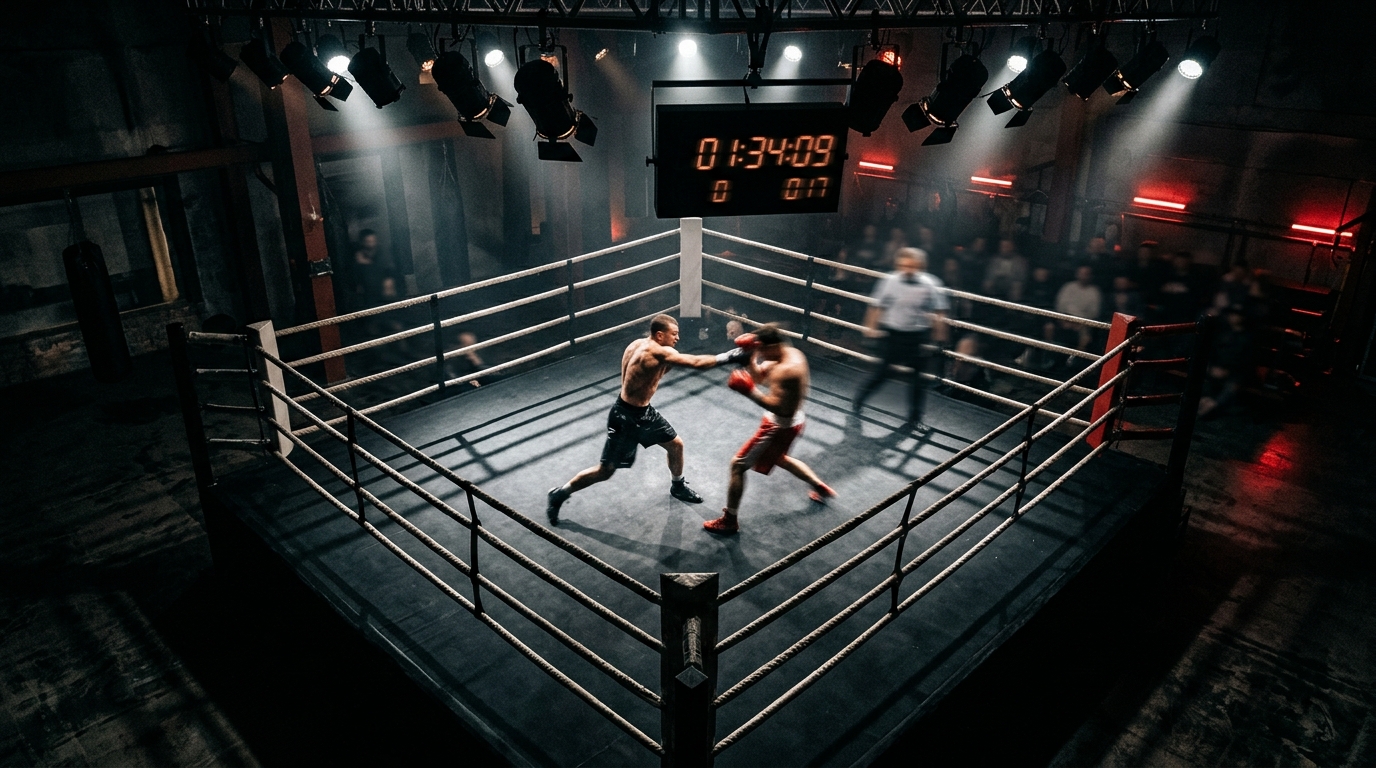
The Invisible Art That Separates the Good from the Great
There's an element in combat sports that rarely gets discussed openly, yet every experienced coach recognizes it instantly: timing. We're not talking about raw speed or devastating power, but that almost magical ability to be in the right place at the right moment, to strike in the exact instant when your opponent is vulnerable. Floyd Mayweather Jr. was never the most powerful or fastest boxer in his division, yet he built an undefeated career (50-0) thanks to perfect timing. Israel Adesanya in MMA has made rhythm management his distinctive signature, just as Saenchai in Muay Thai continues dominating younger, physically stronger opponents through exquisite timing.
Timing is what transforms a telegraphed strike into an unexpected knockout, what allows you to slip punches with millimeters to spare instead of relying on wide, energy-draining movements. It's the difference between reacting and anticipating, between fighting and dictating the pace of the match.
The Science of the Perfect Moment
Timing in combat sports is fundamentally about perception, anticipation, and coordinated execution. Studies in sports biomechanics and neurology have shown that elite fighters don't necessarily have faster reaction times than average, but possess a superior ability to read the preparatory signals of opponent movements.
When a boxer throws a jab, there are preparatory micro-movements: an imperceptible weight shift, a slight shoulder tension, a change in eye angle. Champions learn to recognize these "tells" and react not to the punch itself, but to the signals that precede it. This explains why Juan Manuel Márquez knocked out Manny Pacquiao in their fourth fight with that devastating counter right: it wasn't luck, but the result of years studying the Filipino's attack patterns.
Timing manifests in three primary forms: offensive timing (striking when the opponent is exposed), defensive timing (slipping or blocking at the optimal moment), and disruptive timing (breaking the opponent's rhythm). Great champions master all three dimensions.
Mayweather and the Perfect Metronome
Floyd Mayweather Jr. probably represents the most studied example of perfect timing in modern boxing. His defensive strategy relied on millimetric calculations: he'd allow opponents to start their combinations, then slip out of range with minimal movements, often just inches, making them hit air. The moment when the opponent completed their motion into emptiness was exactly when Mayweather would counter with surgical precision.
Against Canelo Álvarez in 2013, Mayweather delivered a masterclass in rhythm control. The young Mexican was bigger, stronger, and threw combinations from various angles, but Mayweather made him look slow and predictable. How? By constantly alternating his rhythm: sometimes responding immediately, other times waiting a split-second longer, completely disrupting Canelo's offensive timing.
Mayweather's signature "shoulder roll" is essentially an exercise in perfect timing: the shoulder lifts and rotates exactly when the opponent's punch arrives, deflecting it with minimal effort. Execute it too early, you're left exposed; too late, you eat the shot clean. Mayweather perfected it to the point where he seemed to have all the time in the world.
When Rhythm Becomes Deception: Adesanya and Distance Control
Israel "The Last Stylebender" Adesanya brought to MMA a timing sensitivity typical of the best kickboxers and boxers. His primary skill doesn't lie in the power of individual strikes, but in his ability to manipulate opponent rhythm, creating false expectations and then violating them.
In his match against Robert Whittaker for the UFC middleweight title in 2019, Adesanya showcased a catalog of rhythmic variations. For most of the first round, he maintained a constant rhythm of jabs and low kicks, almost hypnotic. Whittaker began synchronizing with that rhythm, anticipating the strikes. Then, suddenly, Adesanya broke the pattern with a lightning-fast combination that culminated in a second-round knockout.
This principle of "rhythm breaking" is fundamental: when you create a repetitive pattern, the opponent unconsciously begins moving in sync with you. Breaking that pattern at the right moment creates a window of vulnerability. Adesanya applies this concept with feints too: repeated fakes create hesitation, and when the opponent stops reacting, the real strike slips through uncontested.
Saenchai: The Master of Advanced Reading
In Muay Thai, Saenchai Sor Kingstar represents a unique phenomenon: at over 40 years old, he continues dominating much younger opponents, often conceding significant weight advantages. His secret lies in timing so refined it seems like precognition.
Saenchai is famous for his cartwheel kicks and acrobatics, but behind the apparent showmanship lies superior fight reading. Watch his matches carefully: he's rarely hit clean. Why? Because he moves before the opponent completes the thought of attacking. He recognizes intention in micro-changes of posture, breathing, gaze.
One of his signature techniques is the catch kick followed by sweep or knee strike. Catching a kick requires perfect timing: too early and the leg isn't extended yet, too late and you've already been hit. Saenchai does it with a nonchalance that makes it look simple, but it's the result of decades of experience and thousands of repetitions.
The Thai also masterfully applies the concept of "dead timing" - striking when the opponent changes position, transfers weight, or finishes a technique, moments when they're biomechanically compromised and can't defend effectively.
The Counterpunchers: When Timing Becomes a Trap
Some boxers build entire careers on defensive-offensive timing, transforming every opponent attack into an opportunity. Juan Manuel Márquez was the master of this art in boxing. His knockout of Pacquiao in 2012 wasn't a lucky shot, but the perfect conclusion of a strategy studied across four fights.
Márquez understood that when Pacquiao attacked with his lead left, he tended to lean slightly forward with weight on his front foot. For three and a half fights he'd studied that pattern, and in the sixth round of the fourth match he saw the opening: as Pacquiao lunged forward, Márquez fired a perfectly timed right that met the Filipino in his forward movement, multiplying the impact. Result: one of the most spectacular knockouts in boxing history.
In kickboxing, Giorgio Petrosyan built a similar reputation. Nicknamed "The Doctor" for his surgical precision, Petrosyan excels at counter timing. His typical strategy involves absorbing or slipping the first strike of a combination, then inserting a counter right hook or knee exactly when the opponent completes their second or third shot. This requires immense courage - you must let the opponent start attacking - but when executed correctly, it's devastating.
Breaking the Rhythm: The Strategy of Controlled Chaos
Not all champions seek perfect timing the same way. Some excel at creating controlled chaos, constantly breaking rhythm to prevent opponents from establishing their own timing. Manny Pacquiao in his prime was the master of this approach: unpredictable angles, sudden rhythm changes, high volume of strikes from unorthodox positions.
This "anti-timing" strategy works because it overloads the opponent's decision-making system. Instead of recognizing patterns and anticipating, the opponent is forced to continuously react, always a step behind. It's not a strategy for everyone - it requires exceptional cardiovascular conditioning and the ability to maintain coordination and balance even when moving unconventionally.
In MMA, Max Holloway uses a similar approach: high volume, constant rhythm changes, attacks from multiple angles. During his reign as UFC featherweight champion, Holloway often won matches with a "production pace" that simply exhausted opponents' defensive capacity.
What You Can Take to the Gym
Timing can be trained, but requires different approaches than simply working the heavy bag. Here's what you can do concretely:
Specific drills to develop timing:
- Counting drill: work focus pads with your coach calling combinations at variable rhythms - rapid 1-2-3, pause, single strike, long pause, flurry. Learn to sync with unpredictable rhythms
- Slip drill with partner: partner throws single jabs while you practice slipping without watching the glove but the shoulders and torso, anticipating the movement
- Catch and counter: with shin guards, partner throws round kicks at controlled intensity and you practice catching them and responding, developing timing to recognize when the leg is extended
- Timing-specific sparring: rounds where the goal isn't hitting hard but hitting "in dead moments" of the opponent - when they change stance, finish a combination, breathe
- Double-end bag work: the speed bag or double-end bag are excellent for developing timing because the target moves rhythmically but unpredictably
- Mirror exercise: with a partner, one leads and changes rhythm (fast, slow, pauses), the other follows trying to synchronize perfectly
- Intelligent video study: don't just watch matches for action, but pause and look for tells - what does a fighter do half a second before throwing that hook? How do they position before changing levels?
Mental principles to develop:
- Tactical patience: not every moment is right for attacking
- Awareness of your natural rhythm: know your cruising speed to then vary it intentionally
- Pattern reading: every fighter has repetitive tendencies, learn to recognize them quickly
Timing as a Long-Term Advantage
One beauty of timing as a skill is that it improves with experience and age, partially compensating for declining physical attributes. Bernard Hopkins fought at the highest level until 49 thanks to refined defensive timing. Saenchai keeps winning past 40. Mayweather retired undefeated at 40.
This happens because timing depends more on pattern recognition and experience than pure speed or explosive power. An experienced fighter has seen tens of thousands of strikes and can categorize them instinctively: "This shoulder movement precedes a left hook to the body" becomes automatic knowledge, not a conscious process.
Timing is also less dependent on extreme physical conditioning. You can be fatigued and still maintain decent timing, while power and speed decay dramatically with fatigue. This explains why technically superior fighters often dominate late rounds even when both are tired.
Conclusion: The Rhythm You Don't See
Timing remains one of the most underrated skills by amateur practitioners, who tend to focus on power, speed, and individual strike technique. Yet, observing great champions across generations and different disciplines, a clear pattern emerges: whoever controls the rhythm, controls the fight.
Mayweather with his defensive metronome, Adesanya with his pattern breaks, Saenchai with his advanced reading, Márquez with his counter-timing traps - all demonstrate that timing can be more important than any other single physical quality. The good news is that, unlike attributes like reach or height, timing can be systematically developed with the right practice and correct mental approach.
Start viewing your training sessions not just as opportunities to refine technique, but as laboratories to explore rhythm - yours and others'. Pay attention to moments, not just movements. Over time, you'll develop that sensitivity that separates those who strike from those who strike at the right moment, transforming every bag session, every drill, and every sparring round into an opportunity to refine the invisible art that defines true champions.