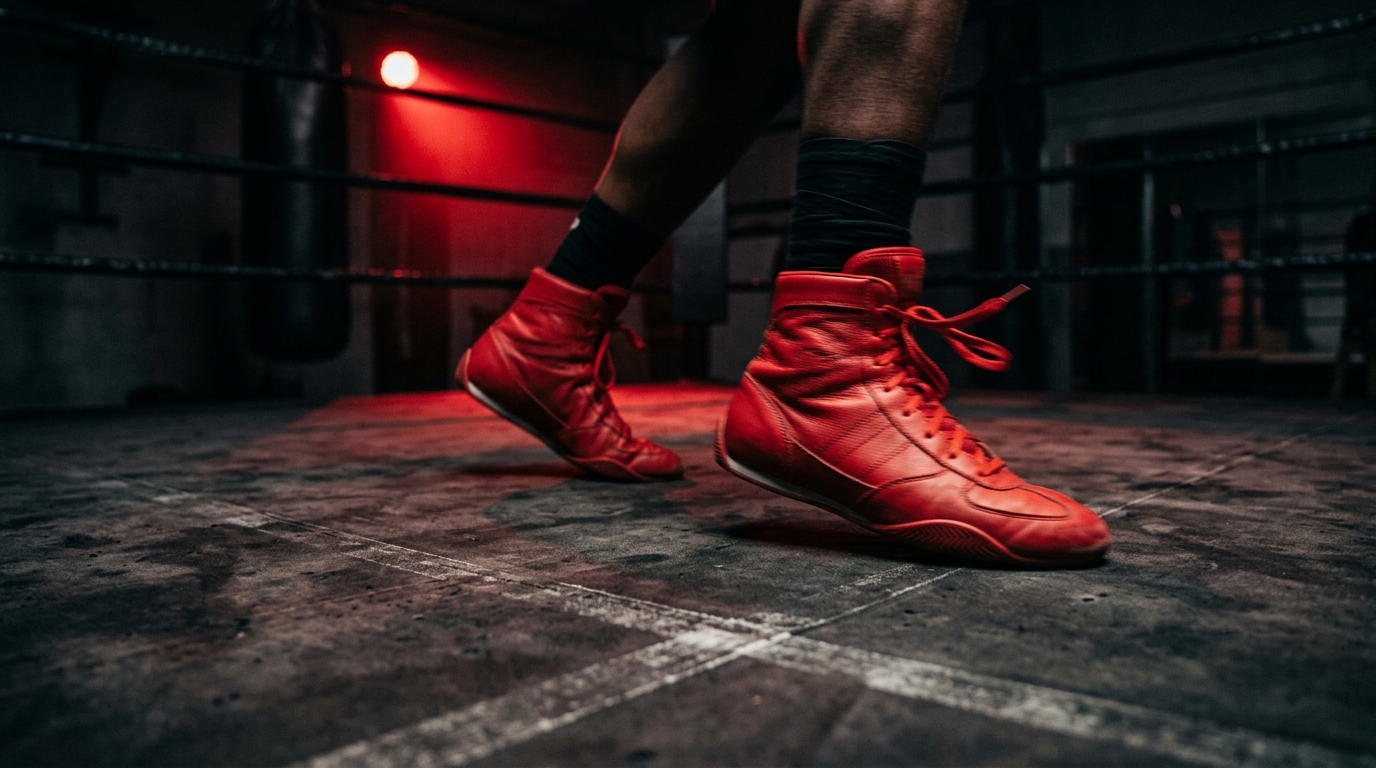
The Invisible Foundation of Victory
Anyone who's watched Muhammad Ali "dance" around an opponent or seen Vasyl Lomachenko materialize at impossible angles knows that boxing is won as much with the feet as with the fists. Yet footwork remains the most neglected aspect of training for beginners and one of the most complex to master even for professionals.
Footwork isn't simply about moving—it's the positioning system that determines power, defense, angles, and pace control. It's the difference between always being in the right place at the right time and getting caught by combinations you never saw coming. In this article, we'll explore how the greatest champions in boxing, kickboxing, Muay Thai, and MMA have transformed footwork into a lethal weapon, and what you can learn from their mastery.
The Biomechanical Foundation: Why Footwork Generates Power
Before analyzing champions' styles, it's essential to understand the physics of movement. Every devastating punch begins from the ground. Force is generated by the rotation of the rear foot, transmitted through the knee and hip, amplified by torso rotation, and finally delivered through the fist.
Without proper foot positioning, this kinetic chain breaks down. A fighter with feet too close together can't generate torque; one with feet too far apart loses mobility and speed. The ideal stance angle varies between disciplines: traditional boxing favors a more frontal position (around 45 degrees), while kickboxing and Muay Thai require a slightly wider stance to defend against leg kicks.
Biomechanics also explains why the "pivot"—rotation on the front foot—is so crucial. When Floyd Mayweather Jr. pivots on his lead foot after slipping a shot, he's not simply avoiding danger: he's repositioning at an angle that leaves his opponent exposed while he remains in perfect balance to counter.
Weight distribution is equally fundamental. Keeping weight centered on the balls of the feet allows for explosiveness and rapid direction changes. Too much weight on the heels makes you slow and vulnerable, while staying excessively on the toes causes premature fatigue.
Muhammad Ali vs Floyd Mayweather: Two Philosophies, One Mastery
Analyzing the footwork of Muhammad Ali and Floyd Mayweather Jr. reveals two seemingly opposite but equally effective approaches to ring control.
Ali embodied perpetual motion. His strategy relied on constant lateral movement, direction changes, the "float like a butterfly" that made him legendary. Watching his fights against Sonny Liston or Cleveland Williams, you notice how Ali rarely stayed still for more than a second. His quick lateral steps constantly carried him out of the line of attack, forcing opponents to recalculate distance and timing continuously.
Ali's technique included a distinctive "shuffle"—a rapid switching of foot positions that allowed him to create sudden angles. This movement, though seemingly simple, required exceptional coordination and extraordinary conditioning to maintain for 15 rounds.
Mayweather, by contrast, represents economic efficiency. His footwork is minimalist: small adjustments, precise rotations, no wasted movement. While Ali covered the entire ring, Mayweather often operates in tight spaces, using pivots and short but perfectly timed lateral steps. In his victory over Canelo Álvarez, Mayweather demonstrated how to control a younger, more powerful opponent simply by never being where Canelo expected him to be.
Mayweather's "shoulder roll" technique is impossible without precise footwork. His rear foot rotates exactly as the opponent's punch grazes his shoulder, creating a perfect counter-attacking angle. This type of synchronization requires years of deliberate practice.
Both approaches teach a fundamental lesson: effective footwork isn't about quantity of movement, but quality and timing. Ali moved extensively because his style required tiring and frustrating powerful opponents; Mayweather moved less because his style exploited surgical precision.
Saenchai and Muay Thai Footwork: The Art of the Teep and the Evade
In the world of Muay Thai, Saenchai Sor Kingstar represents perhaps the most sophisticated example of how footwork can compensate for physical disadvantages. Regularly competing against opponents significantly heavier and taller, Saenchai has developed footwork that combines traditional Muay Thai elements with creative innovations.
Traditional Muay Thai emphasizes a solid base to withstand kicks and generate power in knee strikes. However, Saenchai has revolutionized this approach with constant movement, lateral angles, and use of the "teep" (front push kick) not only as an offensive weapon but as a distance-control tool integrated into his footwork.
A distinctive characteristic is his "cartwheel kick," possible only through footwork that creates the perfect angle and distance. But beyond spectacular techniques, it's his constant stance switching—transitioning from orthodox to southpaw and back—that confuses opponents. This requires not only exceptional balance but also the ability to generate power from both positions.
Saenchai's footwork also demonstrates the importance of adaptability. In Muay Thai, where low leg kicks are constant, footwork must include "checking" (blocking with the shin) without compromising balance. Saenchai manages to control opponents' sweep attempts while always maintaining properly distributed weight.
Western kickboxing enthusiasts can learn much from the synthesis Saenchai represents: mobility borrowed from boxing integrated with the defensive solidity required by Muay Thai leg attacks.
Israel Adesanya: Bringing Footwork to MMA
MMA presents a unique challenge for footwork: you must be mobile for striking exchanges but ready to defend takedowns. Israel Adesanya has demonstrated how kickboxing footwork can dominate in the octagon, despite the constant threat of wrestling.
Before transitioning to MMA, Adesanya built an impressive record in kickboxing (over 80 fights with numerous victories), developing footwork based on distance, angles, and octagon center control. His victory over Robert Whittaker at UFC 243 was a masterclass in positioning: Adesanya kept Whittaker constantly off-balance, circled toward the weak side, and used his jab and teep to control distance.
What distinguishes Adesanya's footwork in MMA is his ability to maintain the upright posture of kickboxing while minimizing takedown risk. This is partially possible due to his excellent takedown defense, but also because his footwork always keeps the hips in a power position, ready to sprawl.
Compared to other MMA strikers like Anderson Silva, Adesanya shows more lateral movement and less reliance on backing up. Silva often drew opponents forward to counter; Adesanya prefers to circle and create angles. Both approaches are effective, but Adesanya's reflects the modern evolution of MMA footwork.
An interesting aspect is how Adesanya uses "feint footwork"—small foot movements that suggest an action (a kick, a step forward) without committing, provoking reactions he can then exploit. This level of sophistication requires opponents to process not just hands and legs, but every subtle foot movement.
Common Mistakes and How to Fix Them
Even experienced fighters can develop bad footwork habits that limit their performance. Identifying and correcting these errors is crucial for progress.
Crossing the feet is probably the most common mistake. When feet cross during lateral movement, you lose balance and become vulnerable. The correction requires "step-drag" drills: the foot in the direction of movement goes first, followed by the rear foot "dragging" to reestablish stance.
Bouncing instead of gliding is typical of beginners. Effective movement requires feet to maintain contact (or near-contact) with the ground, allowing instant direction changes. Bouncing leaves you airborne, fully committed to a trajectory you can't change.
Stance too narrow or too wide compromises both mobility and power. A general rule: feet should be shoulder-width apart or slightly wider, with the rear foot slightly offset (not directly behind the front foot). This position offers both lateral and front-to-back balance.
Flat feet on the floor eliminates explosiveness. Weight should be predominantly on the balls of the feet, with heels barely grazing the ground. This allows the "spring loading" necessary for rapid movements.
Moving without purpose wastes energy. Every movement should have a goal: create an angle, exit range, enter to strike, or control ring center. Random footwork makes you predictable and tired.
Correcting these errors requires conscious practice. Many coaches recommend dedicating specific time to "pure footwork" without punching, to develop correct muscle memory before adding the complexity of strikes.
Specific Training: Beyond the Heavy Bag
Champions don't develop exceptional footwork through sparring alone. There are specific training methods that accelerate progress.
Agility ladder work is fundamental. Exercises like "in-in-out-out," "Ickey shuffle," and lateral patterns develop foot-eye coordination and foot speed. Vasyl Lomachenko is known for incorporating intensive ladder work into his preparation.
Shadow boxing with movement emphasis means reducing punch power and focusing completely on positioning. Some coaches suggest practicing shadow boxing with heavier shoes or light ankle weights to develop specific endurance.
Working the ring corners teaches using geometry. Drills that require escaping corners using pivots and lateral movements—never simply backing up—develop the instinct to always seek the best angle.
Specific partner drills include the "mirror drill" (where one partner leads and the other mirrors movements) and the "touching game" (where partners try to touch each other while maintaining defensive footwork). These develop reactivity and spatial awareness.
Specific calf and ankle conditioning is often overlooked. Jump rope (obviously), but also plyometric exercises like jump squats, box jumps, and explosive calf raises build the power necessary for explosive movement round after round.
What You Can Take to the Gym
Here are practical applications to immediately improve your footwork:
- Record yourself during shadow boxing: seeing your own movements reveals flaws invisible when you're focused on execution. Compare with champion footage.
- Practice the "pivot drill": from guard position, rotate on the front foot 90 degrees left and right. Do this 20 times per side, focusing on speed and keeping guard high.
- Use lines and markers on the floor: position tape to form a grid. Practice movement touching specific points, developing precision in positioning.
- Incorporate footwork into warm-up: instead of static jogging, practice specific boxing movements—laterals, pivots, step-drags—as part of the warm-up routine.
- "Stick and move" with the heavy bag: hit once, then immediately move to an angle. Don't allow yourself to stay stationary. This develops the habit of striking and immediately repositioning.
- "Triangle" exercise: create an imaginary triangle. Move rapidly to the three points in sequence, rotating your body as if defending or attacking from each position.
- Technical sparring with footwork focus: dedicate specific rounds where the goal isn't to hit hard but to maintain superior footwork. Whoever controls position wins the round.
- Conditioning: movement-only rounds: set the timer for 3 minutes. Move constantly as in a fight (step, pivot, angle, change direction) without stopping. Repeat for 6-12 rounds with 1-minute rest.
Conclusion: The Ring as a Chessboard
Footwork transforms the ring from a simple physical space into a three-dimensional chessboard where position, timing, and angles determine every exchange. The champions we've analyzed—from Ali to Mayweather, from Saenchai to Adesanya—demonstrate that there's no single "perfect footwork," but rather an infinite variety of approaches that can be adapted to your body, style, and goals.
What unites all these elite athletes is the understanding that footwork isn't a separate skill to learn and then forget, but the foundation on which to build every other technique. The fastest jab is useless if you're out of position; the most powerful combination fails if your feet don't generate the necessary force.
For the modern practitioner, the good news is that footwork can be improved at any level. It doesn't require expensive equipment, doesn't depend on unattainable innate athletic gifts, but only on conscious and consistent practice. Every minute dedicated to improving footwork translates directly into better performance in the ring.
The next time you step into the ring or start a training session, remember: before thinking about what shots you'll throw, think about where your feet will be. Because as legendary coach Cus D'Amato once said: "Boxing is a dance, and whoever can't dance can't fight."